ride
Rampart Reservoir: One Loaded Lap, One Full Campground
A loaded lap around Rampart Reservoir with Fixie Dave, a fully booked Thunder Ridge Campground, a dispersed camp under Pikes Peak, and two different ways back home.
- Date
- 2026-09-26
- Region
- Colorado
- Country
- USA
- Distance
- 14.2 mi
- Elevation gain
- 1163 ft
- Elevation range
- 9039–9518 ft
- Technical difficulty
- Beginner-Intermediate
I announced this one back in August as the low-stakes version of a bike overnight: load some gear, ride around a reservoir, sleep at a real campground with real vault toilets, ride back. No Tour Divide cosplay required. What I did not announce, because I had no way to know yet, was that Thunder Ridge Campground would be full when we got there and we'd end up finding our own spot on Rampart Road instead. More on that shortly.
Fixie Dave and I rode it. The Krampus went rigid and single speed, fully loaded with a bikepacking kit for the first real test since I put the Rogue Panda frame bag and the Surly rigid fork on it. Dave brought his Jones, a fat bike running a 5-inch front tire and a 4-inch rear, also rigid, also single speed, at 34x22. Between the two of us that's zero suspension, zero derailleurs, and a genuinely absurd amount of rubber on the ground. Nothing broke. Nothing even threatened to break, which after months of planning this bag-and-fork setup around a spreadsheet's worth of gear decisions felt almost anticlimactic.
The Route
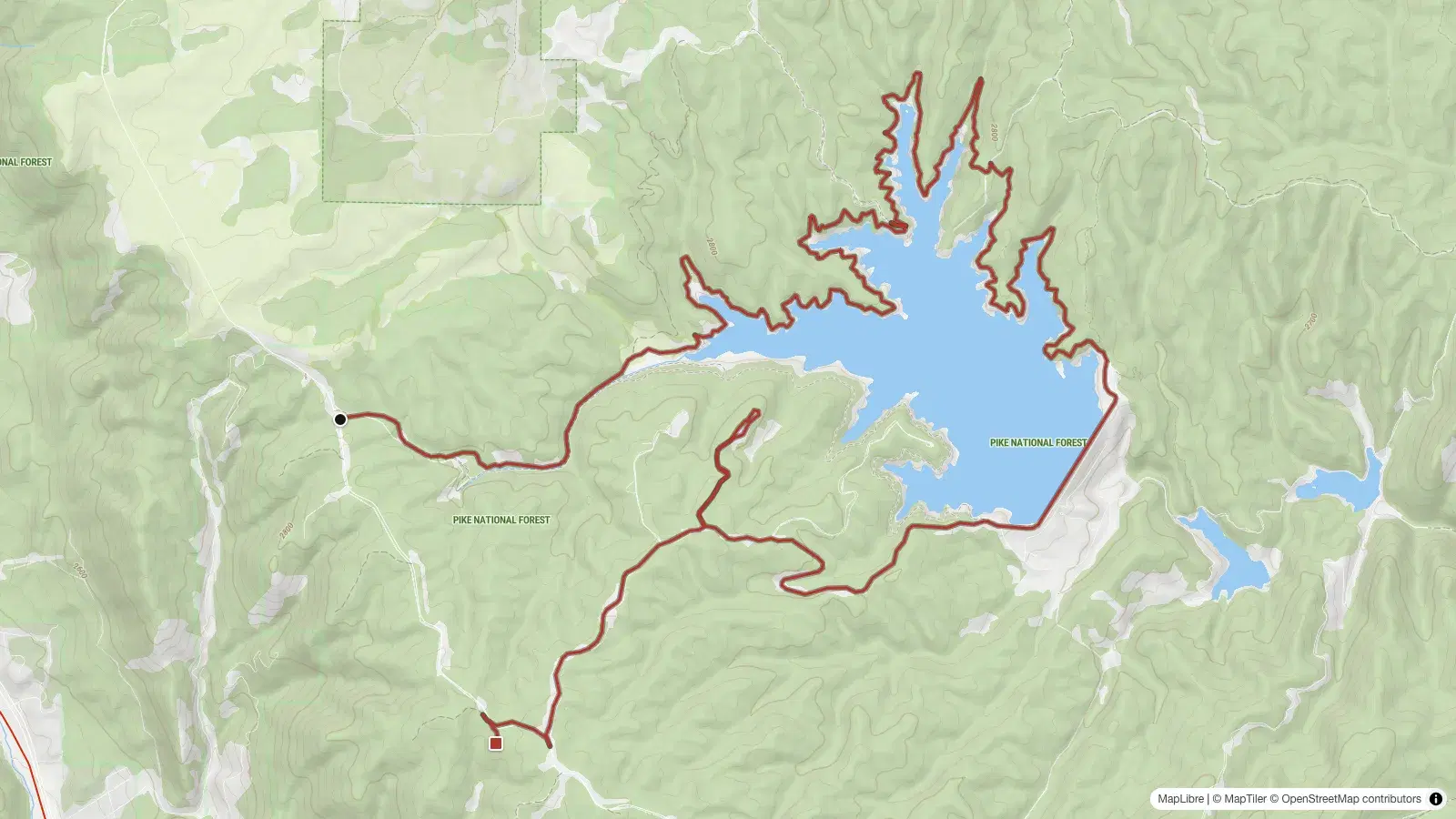
Rampart Reservoir sits around 9,000 feet in Pike National Forest, between Denver and Colorado Springs, just outside Woodland Park. The route starts at the Rainbow Gulch trailhead, drops onto Rainbow Gulch Trail #714, picks up Rampart Reservoir Trail #700, and follows the shoreline the long way around, clockwise in our case, before connecting into Thunder Ridge Campground.
The Forest Service lists Trail #700 as an easy, nonmotorized loop. Trailforks rates it green and flags the same Pikes Peak "kitty litter" surface you get on basically every trail within thirty miles of the mountain, decomposed granite that looks stable and occasionally is not. MTB Project puts the full Rainbow Gulch loop at right around fourteen miles and calls it approachable for newer riders while still throwing in enough scattered technical bits to keep more experienced ones paying attention. That description held up. There's no single defining climb. The trail works its way around a long series of coves and drainages, so the elevation gain comes in a lot of small, repeated deposits rather than one bill you pay all at once.
Saturday's leg, the ride out to camp, came out to just over fourteen miles and about 1,160 feet of climbing, topping out around 9,500 feet.
That rolling, low-consequence profile is exactly why this loop works loaded. A green/blue trail with a lot of small ups and downs and not much exposure is a very different proposition on a rigid single speed carrying a tent than it is on the same bike empty. You don't need suspension you don't have, and you don't need gears you don't have either. You need a trail that doesn't punish you for missing both.
None of it asked anything of the weather either. Highs in the low 70s, lows dropping into the mid 40s overnight, full sun both days, and the aspens just starting to turn. About as good as late September at 9,000 feet gets.
Saturday: Kitty Litter and Cargo
Rainbow Gulch drops fast enough to remind you the bikes are carrying more than usual before you've gone half a mile. Loose granite under a loaded front end behaves differently than loose granite under an unloaded one: a little more momentum, a little less interest in changing direction quickly. Nothing dramatic, just a reminder to plan corners a few feet earlier than habit suggests.
Trail #700 itself rolls around the reservoir's edge through pine and rock outcrops, with the water visible often enough to remember why you're out there and hidden often enough that it doesn't get old. The climbing shows up in short pitches as the trail cuts in and out of each drainage, which on a single speed means standing more than you'd like on a loaded bike and coasting more than you deserve on the way back down each one. Rigid and loaded is not the fastest way to cover this kind of terrain. It is a completely reasonable way to cover it, which is a different and more useful claim.
We stopped when we wanted to stop. There was no schedule to protect beyond making camp before dark, which on a fourteen-mile day with no fixed start time is not a demanding schedule.
Thunder Ridge Was Full
The plan, same as the one I'd posted in August, was to reach Thunder Ridge Campground, refill water, and set up for the night at a real site with a real picnic table. I'd even written, in the announcement for this trip, that camping around the reservoir is restricted to developed sites, so this wasn't going to be a dispersed-camping trip where we'd go hunting for a patch of ground at the end of the ride. We'd know where we were sleeping before we started.
Thunder Ridge Campground was full.
Not out of water, not closed for the season, full in the ordinary sense of every site already having a tent or a truck camper on it. I'd hedged against the water being shut off for the shoulder season. I had not hedged against a Saturday night in late September being popular enough to book out a Forest Service campground.
So we topped off what water we could and kept riding, further down Rampart Road, looking for the version of "developed campground" that dispersed camping actually is, which is to say a wide spot with decent ground and nobody already standing on it. We found one a little further along with a clean view toward Pikes Peak and enough flat dirt for two bikes and two tents. It was not the plan. It turned out to be the better one anyway: no campground loop, no neighbors, no picnic table between us and the mountain, just a private clearing with a better sightline to Pikes Peak than any of Thunder Ridge's actual sites get.
Camp
Dinner was the usual bikepacking arithmetic: boil water, add it to a bag, wait, regret nothing. Pikes Peak sat there being enormous in the way it does from almost anywhere in the county, slightly more impressive than usual from a spot we hadn't picked out in advance. Cold enough at altitude to drop into the mid 40s overnight, cold enough to make the sleeping setup worth the weight it had cost getting there. This was also the first real shakedown for a few pieces of that kit, and it found problems. More on that below.
Sunday: Coffee, Then Two Ways Back
Sunday morning was coffee, breakfast, and the slower-than-it-should-be process of getting camp back onto two bikes in a configuration that was somehow not the one that worked the day before. This appears to be a universal law of bikepacking rather than a personal failing.
Then we split up, which is not how I'd originally planned the return leg, but Rampart Road was right there and Dave had a powerline trail down to Cascade he wanted to try on the Jones. I rode Rampart Road a few miles back to the trailhead and my car. Dave pointed the fat bike downhill toward Cascade instead. Neither route is documented here with a GPX or an elevation profile, since neither of us recorded it and the point of Sunday was never to complete a perfect loop, just to get back to where we'd started, however we each felt like doing it.
How the Gear Held Up
No mechanicals. No flats, no dropped chains, no complaints from the Rogue Panda bag or the Surly rigid fork about being asked to do their actual job for the first time. The rigid single-speed Krampus, loaded, handled a green/blue reservoir loop exactly as well as a green/blue reservoir loop should be handled by a bike with no suspension and one gear, which is to say fine, because that's what the trail was for. Dave's Jones, similarly rigid and similarly geared down to one option, seemed entirely unbothered by carrying camping gear on tires wide enough to argue they didn't need to be bothered by much of anything.
The bikes did exactly what rigid single speeds loaded with camping gear are supposed to do. The rest of the kit was a different story.
A Few Things Didn't Go Particularly As Planned
The bikes did their job. The rest of the kit had opinions.
The Snow Peak titanium spork, it turns out, is not long enough to reach the bottom of a Peak Refuel bag once the food has actually rehydrated down into it. I spent more of Saturday night excavating dinner than eating it with any dignity. Dave, who has apparently thought about spoon length longer than I've thought about most life decisions, recommended the Sea to Summit Long-Handled Titanium Spoon. That's now on the list.
The Sea to Summit 3L dry bag was a different problem. It held the tent fine at the trailhead Saturday morning, back when the tent was still folded the way the factory folded it. By Sunday, after one night of actual use, it had opinions about ever going back in that bag, and packing up turned into a genuine wrestling match I did not clearly win. I need a slightly bigger bag. The complication is that the downtube barely fits the 3L I already have, which is the entire reason I bought a 3L instead of something larger in the first place. So the next bag up isn't going in the frame. It's getting mounted to the fork instead.
Fuel ran shorter than planned too. I'd tested the stove at home, at 6,000 feet, in a kitchen with zero wind. Camp was at 9,000 feet with an actual breeze, and apparently both of those cost real fuel efficiency instead of just looking bad on paper. I didn't run out. I noticed the bottle getting lighter faster than the math said it should.
The tipi's single center pole doesn't fit inside anything I own, bag-wise, so it travels strapped to the outside of the handlebar bag, sticking out like a lance. Dave's already solved this on his own tipi by building a custom breakdown pole out of sections of carbon fiber, which is the kind of project that requires both time and a specific brand of patience I apparently haven't acquired yet. It's on the list, filed somewhere below the spoon.
The sleeping pad situation was self-inflicted. I brought my wife's inflatable pad instead of my own, mostly because it packs smaller, which mattered given the dry bag was already fighting me for space. It's also sized for someone who isn't me, and I spent the night finding the exact dimensions of that mismatch. Next time I'm bringing my actual pad, which is no fun to inflate at 9,000 feet after a full day of riding, or skipping the inflation problem entirely with a foam pad instead.
Fixie Dave reported none of this. No spoon problems, no bag problems, no fuel surprises, no pole or pad drama, which tracks for someone who has been doing this specific kind of trip since before I owned a bike with disc brakes. His resume includes finishing the Great Divide route from Antelope Wells to Banff, which is the kind of credential that makes "my dry bag was slightly too small" sound like the minor problem it actually was.
Small stuff, all of it. But small stuff is exactly what a trip like this is supposed to find, before a bigger trip finds it for you.
Practical Notes
- Water: Do not assume Thunder Ridge has water running, and as of this trip, do not assume it has an open site either. Plan for both, and know that the surrounding road has usable dispersed camping if the campground doesn't work out, developed-camping-only signage notwithstanding.
- Surface: Kitty litter decomposed granite throughout. Predictable when dry, worth respecting when loaded.
- Camping rules: Camping directly around the reservoir shoreline is restricted to developed sites. Dispersed camping is an option further out along Rampart Road, not at the reservoir itself.
- Bike choice: A rigid single speed is not a disadvantage here, whether it's running skinny tires or fat ones. A loaded rigid single speed still isn't.
- Weather: Late September at 9,000 feet can go either way. We got highs in the low 70s, lows in the mid 40s overnight, full sun both days, and aspens just starting to turn. Don't count on repeating it.
- colorado
- rampart-reservoir
- bikepacking
- bike-overnight
- mountain-bike
- single-speed
- camping