ride
Single Speed USA 2026: One Gear, Several Beers, and One Sun-Baked Climb
A single-speed championship weekend in Richfield, Utah: one brutal climb, a bunch of asses, and a beer-chugging contest that decides where the whole thing happens next year.
- Event
- Single Speed USA 2026
- Date
- 2026-06-13
- Region
- Utah
- Country
- USA
The first thing to understand about Single Speed USA is what it is not.
It is not a serious race, even though there is technically a course, a start, a finish, and people capable of riding much faster than you. It is not a festival of matching spandex, carefully measured carbohydrate intake, or people loudly discussing their FTP within earshot of strangers. Most importantly, it is not full of twats.
Single Speed USA is a full-on party populated by people who love bicycles so much that they have deliberately removed most of the gears from them. One gear is enough. Apparently several beers are also required.
People sometimes describe single speeding as the "punk rock of cycling," which is not entirely wrong, but feels a little too tidy. It is the sort of phrase that belongs in a brochure next to a black-and-white photograph of somebody riding without a helmet. Single speeding is less calculated than that. It is part stubbornness, part simplicity, part bad judgment, and part genuine affection for riding a bicycle without turning every ride into a data-analysis project.
Single Speed USA takes all of that and adds costumes, questionable haircuts, beer, heat, and enough actual riding to remind everyone that the joke still requires some fitness.
The Road to Richfield
Fixie Dave met me in Golden, and we loaded the bikes onto my Nissan Armada for the drive to Richfield, Utah.
The Armada is the poor man's Toyota Land Cruiser. It is large, thirsty, and capable of carrying enough bicycles and gear to support the illusion that I know what I am doing. It lacks the international expedition credibility of a Land Cruiser, but it does have air conditioning, which would become the most important feature of the weekend.
Dave does not own a car. This is relevant because he seems to know every road, town, mountain pass, water stop, campground, and forgotten intersection in the American West. He has seen much of it from a bicycle, which is a much slower and apparently more permanent way of learning geography. I see a highway exit and wonder whether there is a gas station. Dave sees it and remembers where the water fountain is, which direction the prevailing wind blows, and probably the name of a guy who once let him sleep behind a shed.
It made for a good drive. We talked about bikes, old trips, new trips, people we knew, places Dave had ridden, and places I had mostly driven through while eating something from a gas station.
It had been a long time since I had traveled west on Interstate 70 through that part of Utah. Like most Colorado mountain bikers, my relationship with Utah had become overly centered on Moab. Turn south, ride slickrock, eat a hamburger, drive home. I had forgotten how much country sits beyond that familiar exit.
The landscape opened into the San Rafael Swell, or at least what I was fairly sure was the San Rafael Swell, and then kept changing. Massive walls of rock gave way to wide-open desert, followed by unexpectedly green mountains and valleys. Utah kept rearranging itself outside the windshield.
Richfield was more desert than I expected. The forecast did not look especially terrifying on paper, which was comforting right up until we got out of the vehicle. It was dry, exposed, and well, fucking hot. Morning and evening were tolerable. The middle of the day felt as though the sun had developed a personal grievance.
Dave and I shared a hotel room with free breakfast. This was not glamorous, but it had beds, air conditioning, and biscuits and gravy. At Single Speed USA, that is effectively a luxury resort.
Registration at the Only Bar in Town
We rolled into Richfield on Friday evening and headed to what appeared to be the only bar in town.
Typical Utah.
We displayed our credentials, checked in, and were soon holding the first of several beers intended to support better decision-making. Race director Cimarron and the crew from GRO Promotions had taken over a table, and registration went smoothly. Names were checked, instructions were given, and nobody appeared especially concerned that we might be underprepared.
The bar slowly came alive as more riders arrived. Bikes accumulated outside. People who had not seen each other since the previous year started telling stories that were probably true in their earliest versions. Introductions were made, beers were ordered, and everyone discussed the next day's ride with a level of confidence that would not survive the climb.
This is one of the better parts of Single Speed USA. The event attracts people from different towns, different riding scenes, and different levels of apparent sanity, but everyone already shares one very specific defect. They have chosen to ride mountain bikes with one gear and have traveled to another state to do it with other people who made the same mistake.
Richfield itself turned out to be pleasantly bike-friendly. Once we were there, we rode almost everywhere. The hotel, the bar, the start, dinner: it was all close enough that taking the Armada would have felt like cheating. Dave, naturally, was operating under normal conditions. I was briefly experiencing his entire transportation system.
Eight Servings of Biscuits and Gravy
We got our money's worth from the hotel breakfast on Saturday morning.
I had approximately eight servings of biscuits and gravy. That number may be exaggerated, but not by much. I knew we had a significant climb ahead of us and decided that the best preparation would be to fill my body with enough white gravy to insulate a small house.
Sports nutrition has become unnecessarily complicated. There are powders, gels, chews, drink mixes, timing strategies, and detailed calculations involving grams of carbohydrates per hour. I had biscuits and gravy until I became concerned about the structural integrity of the plate.
Then we rode a couple of miles from the hotel to the start.
There was a delay because a youth enduro race was using some of the same trails. We stood around on rigid bikes and short-travel hardtails while groups of young riders passed in full-face helmets aboard enormous long-travel machines.
They looked at us.
We looked at them.
They were probably wondering why a collection of adults had traveled to Utah to ride outdated bicycles uphill in the heat. We were wondering why children needed motorcycles without motors.
There was mutual disdain, but it was mostly ceremonial. They looked properly fast and probably were. We all believed we were rad at one point. Some of us are still pretending.
The Climb
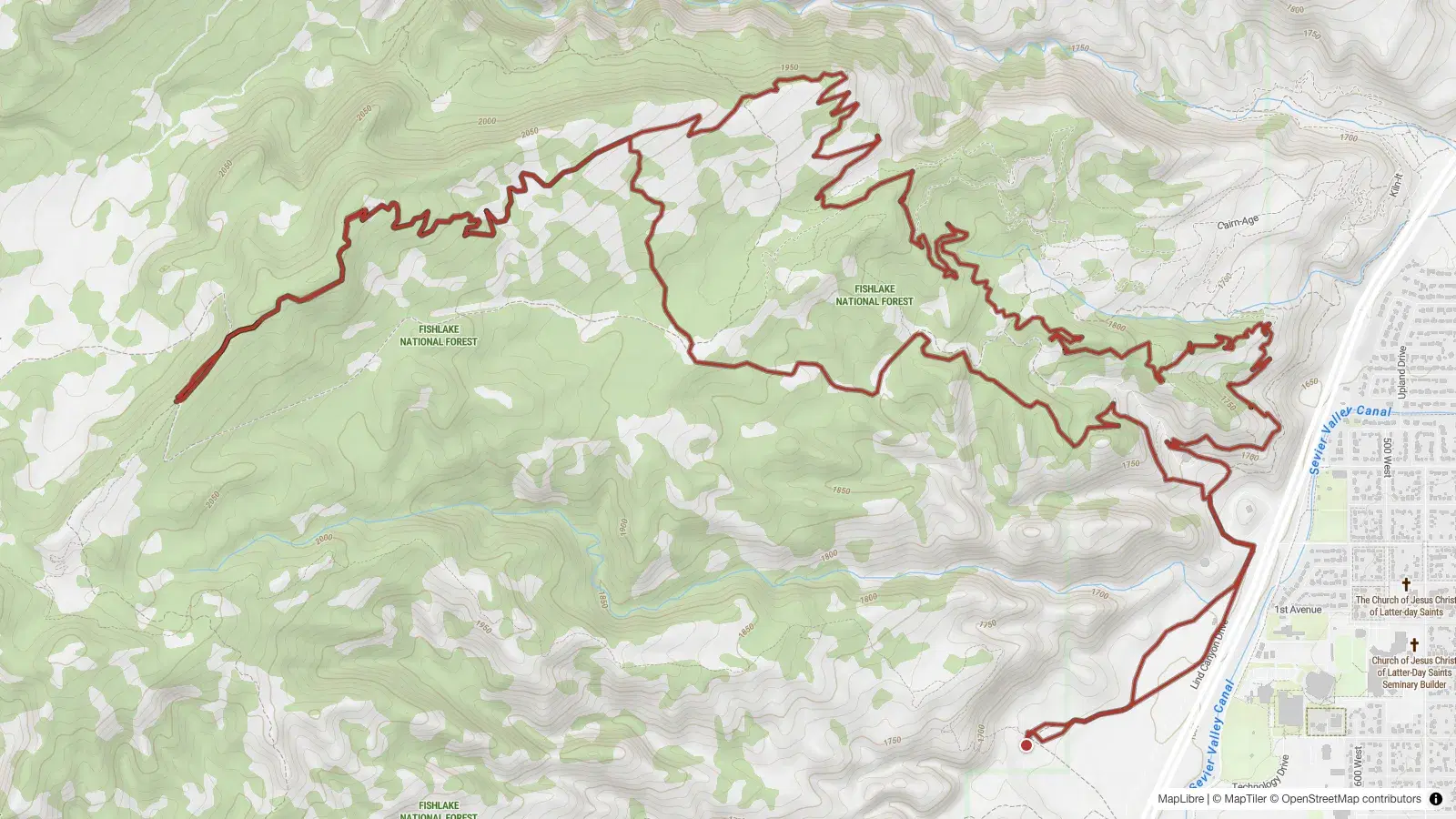
The Richfield course was essentially a loop, but it felt different from the Single Speed USA event I had ridden in Salida in 2024. The climb was longer, bigger, hotter, and far more committed to proving a point.
At roughly seven miles, I began to question whether any of this had been a good idea.
This is not unusual while riding a single speed. The bicycle itself offers very little assistance in resolving doubt. There is no easier gear to select, no small mechanical concession to your declining optimism. You either keep turning the pedals, stand up and turn them harder, or get off and begin the ancient single-speed tradition of walking beside your bicycle while claiming you are saving your legs.
Adding the Utah desert did not improve the situation.
The higher we climbed, the less shade we found. At first, shade meant stopping beneath a tree. Later, it meant standing beside a shrub. Eventually, it meant crouching under brush that could barely conceal a moderately sized rabbit.
The desert has a way of adjusting your standards.
A patch of shadow that would normally be ignored became prime real estate. Water became the greatest beverage ever produced. The possibility of a breeze felt like a rumor worth investigating.
Fixie Dave, meanwhile, continued doing what Fixie Dave does. He rode.
Dave has spent years seeing the world by bicycle. I had spent the morning seeing how much sausage gravy I could carry up a mountain.
We had prepared differently.
Aid Stations as Cultural Institutions
There was an aid station partway up the climb stocked with everything a rider could reasonably want and several things a rider should probably avoid.
There was water. There were snacks. There were drinks, meaning beer. There was also a small jump involving a dildo, because this was Single Speed USA and traditional aid-station standards did not apply.
Most organized rides use aid stations to replenish riders efficiently and send them back onto the course. Single Speed USA uses them to interrupt whatever athletic momentum may have developed.
This is a feature, not a flaw.
The final aid station was less an aid station than a summit celebration with some hydration available. Coolers were full of beer. People stood around talking. Hair clippers appeared, and riders began receiving mohawks, reverse mohawks, bald patches, and other temporary alterations likely to create difficult conversations at work.
Nobody seemed eager to leave.
This is another distinction between Single Speed USA and an actual competitive race. In a race, reaching the top means beginning the descent as quickly as possible. At SSUSA, reaching the top means opening a beer and watching somebody have an unexplained section of hair removed.
Eventually, however, we did need to go down.
A Bunch of Asses
The official descent had developed a reputation by the time we reached it. It was supposedly a legitimate black diamond: steep, technical, and gnarly enough that people discussed it with the particular enthusiasm usually reserved for trails they hope someone else rides first.
At that point, I had consumed a few beers, spent much of the day in the heat, and reached the sort of fatigue where caution can occasionally disguise itself as wisdom. I chose a milder way down with riders from Arizona Single Speed and the Austin Single Speeders.
Both groups can, conveniently, be referred to as ASS.
I descended with a bunch of asses.
Although we skipped the gnarliest official route, we did not gently roll down a gravel road while discussing retirement plans. The alternate descent had drops, jumps, rocks, fast sections, and plenty of opportunities to make a smaller but still respectable mistake.
It was exactly what the climb had been charging us for.
Long single-speed climbs have a strange economic model. You deposit discomfort for several hours and eventually receive a descent. The exchange rate is often poor, but when the trail is good, you stop auditing the transaction.
There was also a 32-inch-wheeled mountain bike in the group. Not a 29er. Not a mullet bike. Thirty-two-inch wheels.
That deserves its own story, because there is only so much unnecessary bicycle behavior one article can responsibly contain.
At the bottom, there was another party. More coolers appeared. There were more drinks, more water, more stories, and the growing realization that the ride had actually been a very good idea now that the climbing portion was over.
Back to the Only Bar in Town
Eventually, everyone worked their way back into Richfield and returned to the same bar.
There was dinner, and the portions were generous enough to suggest that someone understood what we had been doing all day. Riders filled the room, retelling pieces of the course and gradually improving their own performances through narration.
A band called Fur Foxen, from Salt Lake City, played while people ate, drank, and compared the condition of their legs. The event had moved from ride to after-party without any clear boundary between the two.
Then came the contest everyone had been waiting for.
Legend, or at least established tradition, says that the winner of a particular SSUSA competition earns the right to host the following year's event. This is how Single Speed USA selects its next destination. There is no board meeting, formal proposal process, site inspection, or responsible adult oversight.
Instead, people ride bicycles past stacked beers, attempt to grab them while moving, chug them, and repeat until the beers are gone.
It is a game of skill, balance, commitment, and the sort of strategic thinking that becomes less available with each completed round.
Arkansas won.
Therefore, Single Speed USA 2027 will be held in Arkansas.
This is an objectively flawless system of governance.
What Single Speed USA Is
Single Speed USA is difficult to explain because the riding is important, but the riding is not entirely the point.
It is not a competitive race, though some people race it. It is not a costume party, though some people dress accordingly. It is not a beer festival, despite considerable evidence. It is not a convention for obsolete bicycles, because single speeds are not obsolete. They are simply bicycles that have been relieved of unnecessary meetings.
It is a gathering of people who still understand that riding can be both genuinely difficult and deeply unserious.
You can care about making the climb without caring who gets there first. You can ride a technical descent and then spend an hour talking with strangers at the bottom. You can admire somebody's beautiful bike while also appreciating the one assembled from parts that had no obvious reason to work together. You can suffer without needing to convert the suffering into a result.
That may be the real appeal of single speeding. Removing the gears does not make mountain biking simpler in every way. It often makes the actual riding harder. But it removes choices, excuses, and some of the machinery that cycling has accumulated around itself.
There is one gear. The hill is there. Start pedaling.
Richfield was hot, dry, difficult, and a great deal of fun. Fixie Dave spanked me, as expected. I consumed an irresponsible quantity of hotel breakfast. I avoided the gnarliest descent, rode down with a bunch of asses, and watched Arkansas win the right to host an event by successfully drinking beer while riding bicycles.
Whether I will attend in 2027 remains undecided.
That decision will probably depend on how long it takes me to forget the climb.
Historically, not very long.
- ssusa
- utah
- mountain-bike
- single-speed
- race
- culture