ride
Buffalo Creek: Little Scraggy Loop
Thirteen miles of sustained climbing, granite problems, and a long flowy descent around Little Scraggy Peak.
- Date
- 2026-08-16
- Region
- Colorado
- Country
- USA
- Distance
- 12.9 mi
- Elevation gain
- 1427 ft
- Elevation range
- 7686–8518 ft
- Ride time
- 2h 59m
- Technical difficulty
- Intermediate-Plus
Buffalo Creek: Little Scraggy Loop
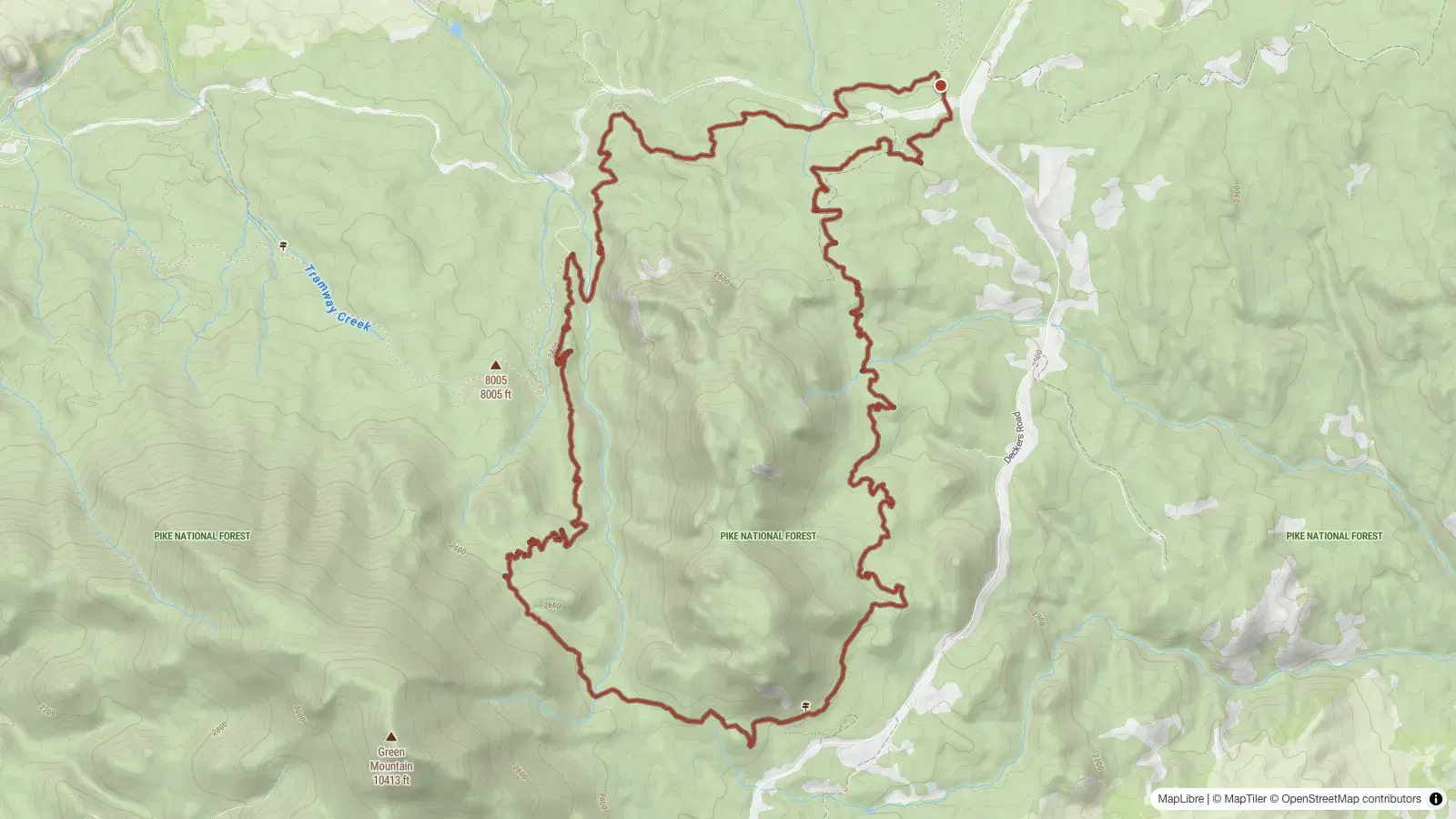
Buffalo Creek has enough trail that it is easy to turn almost any ride there into a twenty-, thirty-, or forty-mile undertaking. Little Scraggy is the opposite. It is a compact loop that leaves the parking lot, spends the better part of seven miles climbing around a mountain, gives most of that elevation back in one long descent, touches the Colorado Trail, and returns you to the same place.
My Garmin file came out to:
- 12.9 miles
- About 1,500 feet of climbing
- High point around 8,520 feet
- 2 hours, 59 minutes elapsed
The high point arrives almost exactly seven miles into the ride, which is a pretty good summary of the route. You spend the first half earning the second half.
Little Scraggy is usually described as an intermediate ride, although the internet cannot completely agree with itself. Trailforks rates the individual Little Scraggy trail blue but gives the complete clockwise route a black diamond because of some of the technical features. That actually makes sense once you ride it. The main line is very manageable for an experienced mountain biker, but there are enough rocks, narrow passages, optional lines, and awkward little problems that calling the whole thing easy would be misleading.
On a single speed, it is a particularly good kind of problem.
Start at Little Scraggy
I parked at the official Little Scraggy Trailhead just off Forest Road 550 and paid the $11 day-use fee.
You can park for free along Pine Valley Road if you can find a legal spot and would rather save the money. I paid the eleven bucks. There is a large parking area, a vault toilet, picnic tables, and enough room to get ready without standing six inches from traffic. Eleven dollars is not the hill I am choosing to die on, particularly at a trail system I would like somebody to keep maintaining.
There is no potable water at the trailhead, so bring what you need.
The important route instruction is simpler:
Ride it clockwise.
You technically can ride Little Scraggy in either direction, but clockwise makes the route make sense. The sustained work comes first, the longer flow section becomes a descent, and most of the optional rock features are approached in the direction where they are more likely to be rolled instead of attacked uphill with misplaced confidence.
From the parking lot, cross Forest Road 550 and get on Little Scraggy.
Then start climbing.
It Does Not Feel Like a Climb Yet
The first mile and a half is deceptive.
The trail rolls through the trees, moves quickly, and feels more like a warmup than the beginning of a seven-mile climb. There are small rises and short descents, but nothing that immediately announces what the elevation profile is doing.
It is flowy enough that you can settle into the bike, find a rhythm, and wonder why anyone would describe the first half of the loop as a sustained climb.
Give it a few minutes.
The trail gradually starts asking for more. The grade increases in small increments and the terrain becomes more technical at roughly the same time. There is no dramatic point where the fun trail ends and the climbing trail begins. It just keeps getting slightly steeper, slightly rockier, and slightly more demanding until you realize you have been working for quite a while.
That gradual progression is one of the things I like about it.
There is no three-mile fire road grind used as an admission fee to reach the mountain biking. You are riding actual singletrack the entire time.
Seven Miles Up
Calling the first seven miles a climb is accurate, but it might give the wrong impression.
This is not seven miles of staring at the front tire while grinding up a continuous grade. Little Scraggy rolls constantly. There are brief descents, flatter sections, corners, rock slabs, and enough changes in terrain that the climbing rarely becomes boring.
You are still gaining elevation.
Your legs will provide independent confirmation.
On a single speed, the grade is generally reasonable enough that the climb remains rideable, but there are plenty of moments where the terrain decides your cadence for you. The steeper pitches arrive with enough rocks mixed in that simply standing up and applying more force is not always the complete solution.
Traction matters. Momentum matters. Pedal placement matters.
That last one becomes increasingly important as the trail works into the granite.
Watch Your Pedals
The technical difficulty on Little Scraggy is not primarily giant drops or terrifying exposure.
It is rocks.
There are sections where the trail squeezes between granite features with just enough room for the bike, assuming the pedals are in the correct place when you pass through. There are chunky little climbs where the obvious line requires putting the front tire somewhere specific, getting the rear tire over the same object, and not smashing a pedal into the rock halfway through the process.
Nothing about this is especially dramatic.
It just demands attention.
That makes the climbing more interesting than the mileage suggests. You can be physically capable of riding the grade and still get stopped because the crank was in the wrong position or the rear wheel hung on a ledge.
A geared bike gives you more options for managing cadence through those sections.
A single speed gives you the gear you installed in the garage and wishes you the best.
I like that.
The Optional Stuff
Little Scraggy has optional rock features scattered all over the loop.
Some are obvious alternate lines. Others look like someone was building the trail, noticed a large piece of granite nearby, and correctly decided that mountain bikers would eventually want to ride over it.
Most of the features I saw were rollable, particularly when ridden clockwise and downhill. There are bigger lines if you want them, but you do not have to turn the ride into a trials competition to get around the loop.
The interesting part is that many of the same features look considerably less friendly while climbing.
A rounded granite slab that is an easy roll on the descent can become a traction and momentum problem going uphill. A rock step that barely registers with gravity helping becomes something you have to actually ride when gravity has joined the other team.
That is another reason clockwise works so well.
You still get technical climbing, but the longer section full of playful features eventually becomes the reward.
Somewhere Around Mile Seven
My GPX reaches the high point at about mile 6.9.
This is useful information if you are on a single speed and have started wondering whether every future mile will continue going upward.
It will not.
Around this point, Little Scraggy turns into a different trail.
The grade tips the right way, the trail opens up, and you finally start spending all the elevation you have been collecting. The descent is long enough to feel substantial without becoming especially difficult.
It is also less technical than much of the climb.
There are berms, rollers, granite features, and long stretches where you can simply let the bike move. The trail winds through the trees with enough visibility to carry speed while still providing optional features for anyone who wants to make things more interesting.
COMBA describes Little Scraggy as natural singletrack with a flow-trail finish, which is probably the cleanest description of the route.
The first half makes you work.
The second half lets you play.
The Downhill Is Not Trying to Kill You
There are Front Range descents where increasing speed mostly means increasing consequences.
This is not really one of them.
The downhill on Little Scraggy has enough rocks and corners to remain mountain biking, but it is generally friendly. Most of the main line is rollable, and the trail gives you space to decide how much of the optional terrain you want to include.
You can ride it quickly.
You can ride it casually.
You can stop and stare at a rock for thirty seconds while convincing yourself that it looked much smaller from the other side.
All are valid.
After spending much of the climb thinking about crank position, traction, and whether one gear was a good idea, the descent feels comparatively uncomplicated.
Point the bike downhill and enjoy the investment.
Navigation Is Almost Too Easy
Buffalo Creek can become a navigational choose-your-own-adventure. There are trails everywhere, and a wrong turn can accidentally add another ten miles to a ride that was supposed to end before lunch.
Little Scraggy is refreshingly simple.
Stay on the loop clockwise. There is a spur toward Kelsey Campground in the first half, but the main route is obvious. Near the end of the Little Scraggy section, you reach the Colorado Trail, Segment 3.
Turn right.
That is the important turn.
From there, the Colorado Trail heads back toward the Little Scraggy Trailhead. You will pass the Shinglemill intersection, which provides an excellent opportunity to turn a thirteen-mile ride into something much larger if your legs have developed unrealistic ambitions.
For this loop, keep going.
The Colorado Trail eventually brings you back to Forest Road 550 and the parking area.
If you have managed to get seriously lost on the standard clockwise Little Scraggy loop, you probably ignored several opportunities to prevent it.
How Hard Is It?
I would call Little Scraggy intermediate-plus overall, but that rating needs an explanation.
Ridden clockwise, the climb is harder than the descent.
The first seven miles gradually become steeper and more technical, and there are enough narrow granite passages, chunky steps, awkward pedal-clearance problems, and short technical climbs that I would call parts of the uphill advanced. None of it lasts forever, and there is usually a reasonable way through, but an intermediate rider should expect to put a foot down or walk a few short sections.
That is not a criticism. Some of the climbing is simply easier to solve with more skill, more power, better timing, or a bicycle with additional gears.
Once the route tips downhill, the difficulty comes down with it. The descent is much more solidly intermediate. There are rocks, corners, and plenty of optional features, but most of the main line is rollable and the trail generally gives you room to choose how ambitious you want to be.
That difference is part of why I like riding the loop clockwise. The harder technical problems arrive while climbing, where failing usually means putting a foot down or walking ten feet. The descent gets to be faster, flowier, and considerably less serious.
Trailforks calling the complete route black and MTB Project landing closer to intermediate both make more sense once you look at the trail this way. A single color does not describe the whole loop particularly well.
If someone asked me at the trailhead, I would probably say:
Intermediate rider? Absolutely. Just expect a few advanced climbing problems and do not be offended when the mountain briefly asks you to walk.
On a single speed, those uphill sections obviously get more interesting. The ratio matters, but not enough to turn Little Scraggy into a gearing experiment with a trail attached.
A Very Good Single-Speed Loop
Some trails work on a single speed because they are flat enough that gearing barely matters.
Little Scraggy works because the gear matters almost constantly.
The first half rewards maintaining momentum and reading the terrain instead of shifting every time the trail changes pitch. The rock sections force you to think about where the pedals are. The short steeper climbs give you reasons to stand up, while the rolling sections provide enough recovery that the entire climb does not become an extended argument with your drivetrain.
Then you get a long descent where nobody needs twelve gears anyway.
That is a pretty good arrangement.
Thirteen miles is also enough distance to feel like you went for a proper ride without turning Buffalo Creek into an all-day project. My ride took just under three hours with stops, which feels about right. Move quickly and it can be shorter. Stop to play on the rocks and it can easily be longer.
There is no reason to hurry.
Ride It Clockwise
That is really the review.
Park at Little Scraggy. Pay the eleven bucks or find legal roadside parking. Cross the road. Ride clockwise.
Enjoy the first mile and a half while it is still pretending not to be a climb. Settle in for the gradual increase in grade and technical difficulty. Pay attention to your pedals when the granite closes in. Try the optional features that look fun and ignore the ones that do not.
Around mile seven, the argument changes.
The trail finally points downhill, the rocks become toys instead of obstacles, and several miles of flowy singletrack return you toward the Colorado Trail.
Turn right when you hit the CT. Ride past Shinglemill. Finish the loop.
It is not the biggest ride in Buffalo Creek, and it does not need to be.
Little Scraggy gives you thirteen miles of very good mountain biking with almost no logistical nonsense, enough climbing to make a single speed interesting, and a descent long enough to make the first seven miles worth it.
That is plenty.
- colorado
- buffalo-creek
- little-scraggy
- mountain-bike
- single-speed